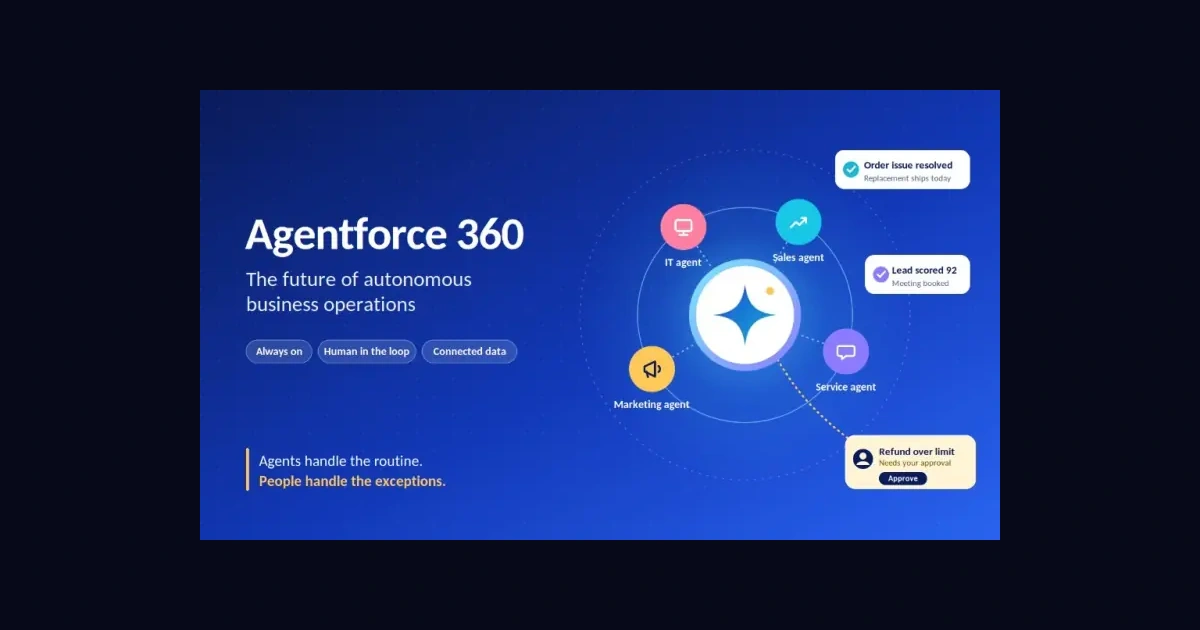
Businesses today are managing more information, customer interactions, and operational responsibilities than ever before. From handling customer inquiries to managing sales activities and coordinating internal teams, organizations depend on multiple applications and systems to keep their operations running smoothly.
Although traditional automation has helped businesses reduce repetitive work, it still has limitations. Most automated workflows follow predefined instructions and struggle when a situation requires additional context or a decision outside the original rules.
Artificial intelligence is beginning to change this approach.
Instead of simply responding to questions or following fixed instructions, modern AI agents can understand requests, work with relevant business information, and perform specific actions within defined permissions.
One of the technologies contributing to this shift is Salesforce Agentforce 360.
Salesforce is moving towards an environment where AI agents, business applications, company data, and employees can work together. The goal is not simply to automate individual tasks but to make business operations more connected, responsive, and efficient.
In this article, we explore Salesforce Agentforce 360, how its capabilities work, where businesses can use it, and what organizations should consider before adopting autonomous AI solutions.
1. What Is Salesforce Agentforce 360?
Salesforce Agentforce 360 is an enterprise AI platform designed to bring together AI agents, business data, applications, and people within a connected business environment.
To understand its importance, consider how customer service usually works in a traditional organization.
When a customer raises a support request, an employee may need to open the CRM, search for the customer’s account, check previous interactions, retrieve order information, and then decide what action to take. This process can involve several applications and consume valuable time.
With an appropriately configured AI agent, some of these activities can be handled automatically.
The agent can understand the customer’s request, retrieve relevant information from connected systems, and perform permitted actions according to its instructions. If the request requires human judgment or approval, it can involve an employee.
This is what makes AI agents different from traditional chatbots.
A chatbot generally focuses on responding to questions. An AI agent can go further by interacting with business systems and carrying out specific tasks.
Agentforce 360 brings these capabilities into the Salesforce ecosystem, allowing organizations to explore AI-powered operations across sales, customer service, marketing, and other business functions.
2. How Does Agentforce 360 Work?
Agentforce 360 connects different Salesforce capabilities to help AI agents understand business requirements and perform assigned responsibilities. Its effectiveness depends on how these components work together.
Agentforce Platform
The Agentforce platform provides the tools needed to create, configure, deploy, and manage AI agents. Businesses can define what an agent is responsible for, what instructions it should follow, and which actions it is permitted to perform.
For example, an organization could configure a customer support agent to answer product-related questions, retrieve customer records, and initiate approved service requests. This makes it possible to develop agents around actual business requirements rather than relying on generic AI conversations.
Salesforce Data 360
Business information is rarely stored in one place. Customer records, purchase histories, marketing interactions, and service information may exist across different platforms. Salesforce Data 360 helps connect and organize this information so that businesses can create a more unified view of their customers.
This is particularly important for AI agents because their responses depend on the quality and relevance of the information available to them. For example, when a customer asks about a previous purchase, an AI agent needs access to the relevant order and customer information to provide a useful response.
Customer 360 Applications
Salesforce provides different applications for managing business activities, including Sales Cloud, Service Cloud, Marketing Cloud, and Commerce Cloud. These applications support different departments, but they can also work together to provide a connected customer experience.
Agentforce can bring AI capabilities into these business environments, helping employees and customers interact with information and workflows more efficiently.
Slack Integration
Communication is an important part of business operations. Employees regularly need information from different departments, systems, and teams. Through Slack integration, organizations can bring AI-powered assistance into their collaboration environment.
For example, an employee could ask an agent to retrieve relevant customer information or assist with a routine business task without manually searching through multiple applications. Together, these capabilities create an environment where AI can become part of everyday business operations.
3. Key Capabilities of Salesforce Agentforce 360
Agentforce 360 offers several capabilities that help organizations explore different approaches to AI-powered business operations.
Autonomous AI Agents
AI agents can be configured to handle specific responsibilities using business instructions, available information, and permitted actions. Unlike a traditional chatbot, an agent can interact with connected applications to complete tasks.
For example, consider an online business receiving hundreds of customer inquiries about order status. An appropriately configured agent could:
- Understand the customer’s question.
- Identify the customer using permitted information.
- Retrieve relevant order details.
- Provide an update about the order.
- Initiate an approved support process if necessary.
This can reduce the amount of manual work required from customer service employees. However, businesses must define clear boundaries to ensure agents do not perform actions beyond their assigned responsibilities.
Agentforce Builder
Creating an effective AI agent requires more than providing a simple instruction. Organizations need to define the agent’s purpose, available information, responsibilities, and actions. Agentforce Builder provides tools to create and customize agents according to these requirements.
For instance, a company may create separate agents for sales support and customer service. Each agent can have different instructions, access permissions, and responsibilities. This approach helps businesses develop AI solutions that match their existing workflows.
Agentforce Voice
Customers communicate with businesses through different channels. While websites and messaging applications are widely used, voice conversations remain important for many customer service operations.
Agentforce Voice brings AI-powered capabilities into voice interactions. It allows businesses to explore more natural customer conversations and automate parts of the support experience. For example, a customer contacting a company about a service request could interact with an AI-powered voice agent to receive information or get assistance with a routine process. More complicated requests can still be directed to human representatives.
Hybrid Reasoning
Business processes often involve a combination of predefined rules and situations that require contextual understanding. Traditional automation is useful when a process follows predictable steps. However, customer requests and business situations are not always identical.
Hybrid reasoning combines structured business logic with AI reasoning. This allows organizations to maintain control over important processes while giving AI agents flexibility when handling different requests.
For example, a refund process may have fixed eligibility conditions, but understanding a customer’s explanation may require additional context. A combination of business rules and AI capabilities can help manage these situations more effectively.
Enterprise Integration
Modern organizations rarely depend on a single software application. They may use Salesforce for CRM, SAP or Oracle for ERP, separate platforms for accounting, and other tools for internal operations.
MuleSoft provides integration capabilities that help connect these different systems through APIs and other integration approaches. This is important because AI agents become more useful when they can work with relevant information across an organization’s technology environment.
4. How Can Agentforce 360 Transform Different Business Departments?
The value of enterprise AI becomes clearer when it is connected to real business requirements. Agentforce 360 can support multiple departments depending on how organizations configure their agents and integrate their systems.
Sales and Lead Management
Sales teams spend a considerable amount of time researching potential customers, updating CRM records, preparing follow-ups, and managing opportunities. These activities are necessary, but they can take time away from customer conversations and relationship building.
AI agents can assist sales teams by retrieving prospect information, helping qualify leads, summarizing customer interactions, and supporting opportunity management.
For example, when a new lead enters Salesforce, an agent could help collect relevant information, evaluate the lead against predefined qualification criteria, and prepare a summary for the sales representative. The salesperson can then review the information and decide how to proceed. This creates an opportunity to reduce administrative work while keeping employees involved in important sales decisions.
Customer Service and Support
Customer service departments frequently deal with similar questions about orders, payments, products, and services. When employees have to handle every request manually, response times can increase, particularly during busy periods.
An appropriately configured Agentforce agent can assist with common inquiries, retrieve relevant customer information, and initiate approved service workflows.
Consider an online retailer receiving a customer complaint about a delayed delivery. The agent could retrieve the order information, check the available delivery details through an integrated system, and explain the current status. If the issue cannot be resolved automatically, it can be escalated to a human representative with the relevant information already available. This can help reduce repetitive work and make customer support more organized.
Marketing Operations
Marketing teams work with customer segments, campaigns, communication channels, and performance information. Managing these activities across different applications can become complicated.
AI agents can assist with customer research, campaign-related workflows, content preparation, and the analysis of available customer information. For example, a marketing team could use AI assistance to identify customer segments based on defined criteria and prepare campaign recommendations. Employees would still review the results and make decisions about campaign execution. The objective is to help marketing teams work more efficiently while maintaining control over their communication strategies.
Employee and Internal Support
AI agents can also be useful for internal business operations. Employees often contact HR, IT, and administration teams to ask routine questions or request information. An internal AI agent could help employees find company policies, understand administrative procedures, retrieve relevant resources, or initiate supported requests. For larger organizations, this can reduce the number of repetitive inquiries handled manually by internal departments.
5. Agentforce 360 vs Traditional Business Automation
Traditional automation has played an important role in improving business efficiency. Tools such as workflow rules, approval processes, and predefined automation help organizations complete repetitive activities consistently.
However, these systems generally depend on configured conditions and predefined execution paths. AI agents introduce a different approach by combining contextual understanding with the ability to perform assigned actions.
Here is how the two approaches compare:
| Feature | Traditional Automation | AI Agents |
|---|---|---|
| Working approach | Predefined rules and workflows | AI reasoning and instructions |
| Decision-making | Based on configured conditions | Uses available context and instructions |
| Flexibility | Best for predictable processes | Can handle varied requests |
| Customer interaction | Usually structured | Can support conversational interactions |
| Exception handling | Often requires manual intervention | Can interpret some exceptions or escalate them |
| Best suited for | Repetitive business activities | Context-dependent tasks and workflows |
This does not mean traditional automation is becoming unnecessary. In fact, combining both approaches can be more effective. Businesses can continue using rule-based automation for predictable activities while introducing AI agents where contextual understanding and flexible interactions are useful.
6. Why Data and Integration Are Critical for Agentforce 360
One of the biggest challenges in enterprise AI adoption is accessing reliable business information. Many organizations have customer and operational data spread across different applications.
For example, a company might use:
- Salesforce for customer relationship management.
- SAP for enterprise resource planning.
- An external payment platform for transactions.
- A separate application for customer support.
- Internal databases for operational records.
When these systems operate independently, employees may have to switch between multiple applications to complete a single task. This creates delays and makes it difficult to maintain a complete view of business activities.
Salesforce Data 360 helps connect relevant business information within the Salesforce ecosystem, while MuleSoft provides tools to integrate different applications and services.
Consider a customer who contacts a company about an invoice. An AI agent could retrieve the customer’s account information from Salesforce, access invoice details through an integrated financial system, and help initiate an approved support workflow. Without proper integration, the agent may only have access to incomplete information.
This is why organizations should evaluate their data quality, system architecture, and integration requirements before introducing AI agents.
7. Security and Governance: What Businesses Should Consider
Giving AI agents access to business applications introduces new responsibilities. Organizations must ensure that agents operate within clearly defined boundaries and follow appropriate security requirements.
Some important considerations include:
Access Control
Agents should only have access to the information and actions required for their assigned responsibilities. Permissions should be designed carefully to prevent unnecessary access to sensitive records.
Data Privacy
Customer and business information must be handled according to applicable privacy requirements. Organizations should understand how information is accessed, processed, and used during AI interactions.
Human Oversight
Not every business decision should be automated. Financial approvals, sensitive customer decisions, and other high-impact activities may require human review.
Activity Monitoring
Businesses should monitor agent activities, review performance, and investigate unexpected behaviour.
Testing and Validation
Before deploying an agent in a production environment, organizations should test it against realistic business scenarios. This helps identify incorrect responses, permission issues, and unexpected actions.
A well-planned governance strategy helps businesses adopt AI while maintaining control over important operations.
8. How Businesses Can Get Started with Agentforce 360
Introducing AI agents across an entire organization can be a significant project. A gradual implementation approach is often more practical. Here are some steps businesses can follow:
Step 1: Identify the Right Business Opportunity
Start by understanding which activities consume the most employee time or create unnecessary operational delays. Common starting points include customer inquiries, lead qualification, internal support requests, and repetitive administrative tasks. Choose a process where the expected benefits can be measured.
Step 2: Evaluate the Existing Salesforce Environment
Review the current CRM setup, data quality, integrations, and existing automation workflows. This helps identify whether the organization has the necessary foundation for AI implementation.
Step 3: Define Agent Responsibilities
Every AI agent should have a clearly defined purpose. Determine what information it needs, which actions it can perform, and which situations require human involvement. Avoid giving agents unnecessary permissions.
Step 4: Configure and Integrate the Agent
Use the appropriate Agentforce tools to configure the agent’s instructions, actions, and business logic. If the agent needs information from external applications, identify the integration requirements and available APIs.
Step 5: Test Different Business Scenarios
Testing should include both common requests and unusual situations. For example, a customer service agent should be tested with incomplete information, unexpected questions, and requests that fall outside its responsibilities. This helps ensure that the agent responds appropriately and escalates situations when necessary.
Step 6: Deploy, Monitor, and Improve
Start with a limited use case rather than immediately deploying agents across every department. Monitor performance, collect employee feedback, and evaluate whether the implementation is achieving its objectives. Use these findings to improve the agent before expanding its responsibilities.
9. What Does the Future Hold for Autonomous Business Operations?
Enterprise software is gradually moving beyond systems that simply store information and execute predefined instructions. Businesses are exploring applications that can understand requests, interact with connected systems, and assist with multi-step workflows.
One emerging direction is the use of multiple specialized AI agents working together.
For example, consider an organization managing the complete customer journey. A sales agent could help identify and qualify a potential customer. After a purchase, a service agent could assist with customer inquiries. Another agent could support internal teams by retrieving information and coordinating approved operational tasks. These agents could work across different applications while employees supervise important activities and handle situations that require human judgment.
However, achieving this level of coordination will require more than deploying AI tools. Organizations will need reliable data, secure integrations, clear agent responsibilities, and well-defined governance policies.
The businesses that prepare their technology environments today will be better positioned to explore these opportunities as enterprise AI continues to develop.
Conclusion
Salesforce Agentforce 360 represents an important development in how businesses can use artificial intelligence within their everyday operations.
By connecting AI agents with business data, Salesforce applications, and external systems, organizations can explore new ways to improve customer service, support employees, and manage operational activities.
However, successful implementation is not simply about introducing AI into existing processes. Businesses must first understand their operational challenges, prepare their data, establish appropriate security controls, and identify where intelligent automation can deliver meaningful results.
The most effective approach is to start with a clear business problem, implement a focused solution, and improve it based on real-world results.
As enterprise AI continues to evolve, Agentforce 360 provides organizations with an opportunity to rethink how people, applications, and intelligent agents work together.
Looking to explore Salesforce AI and enterprise automation?
Skyapex Cloud Solutions helps businesses explore Salesforce consulting, CRM optimization, AI integration, and enterprise solutions designed around their operational requirements. Our focus is on helping organizations identify practical technology opportunities and build solutions that support their digital transformation goals.